
News
Riemann Hypothesis Solution
Following the solution to Navier-Stokes by OpenAI, Anthropic researcher Levent Alpoge has proven one of math’s most famous problems, the Riemann Hypothesis. 35 days ago, Terrance Tao, widely considered to be the greatest living mathematician, said that he expected the Riemann Hypothesis to maybe be solved by 2050. He was off by a little bit it seems.
Levent gave a 4 page writeup, along with a 17 million line Lean formalization of the problem, which has been independently run and corroborated as correct by over a dozen individuals in the math and Lean communities.
The proof, which was expected to need a bunch of new techniques, instead took a tour across many, seemingly unrelated, fields of math. Levent had Claude make a normal writeup at hit over a quarter million pages, so he decided to just publish the Lean formalization for now instead of having a “massive unreadable travesty of slop”.
With this, if it was not already clear, we have reached AGI for math. Navier-Stokes was considered somewhat reachable for humans but the Riemann Hypothesis was widely considered impossible with the tools that we have right now.
Math is the purest field to train on (correctness is very clear and obvious), which is why it has been the first to fall. I’m not as confident that LLMs will be able to solve other fields as easily, but this has shown that we are able to make models that are better than ~all humans in a given field, using just the data generated by humans.
Releases
Gemini 4 Neon
I can’t believe I am saying this, but Google has finally done it and released a frontier level LLM. Gemini 4 Neon is the latest in Google’s deluge of releases the past month, and by far the best.
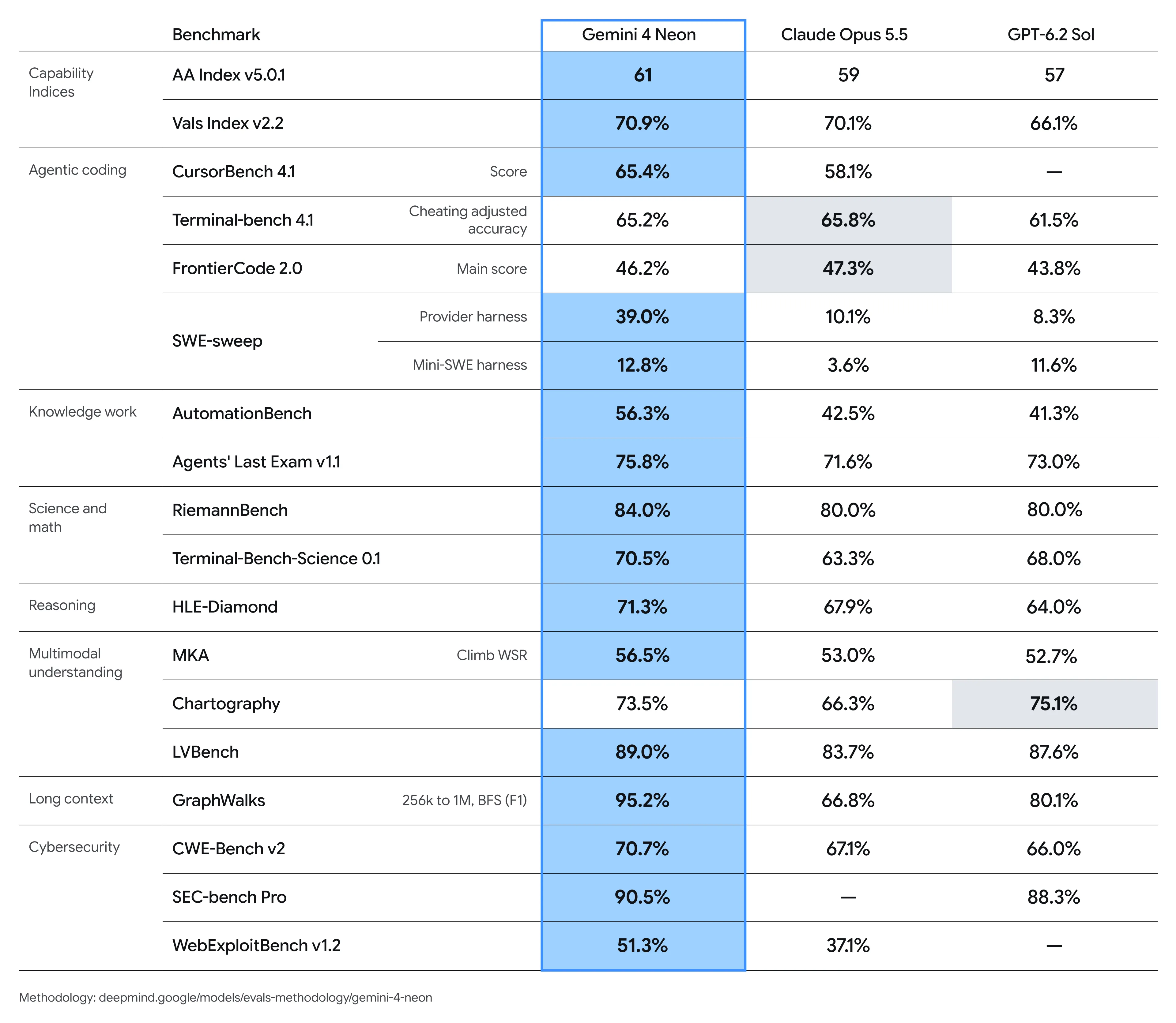
The model does away with the unreliability and hallucinations that had plagued the previous Gemini models, allowing its raw intelligence to shine through. The first thing that you will notice is that the model does particularly well at communication and has a very readable writing style, better than Opus and Fable, and miles ahead of the GPT 6.x models. It also does well at intent inference (the model’s ability to understand your prompt) while also knowing when to push back on your ideas or point out issues beforehand, which most other models struggle to do.
Neon is also extremely capable, being able to complete coding tasks that Astra and Fable struggle with, while writing code that is high quality (the type that a senior software engineer would approve of).
The model is cost efficient as well, sitting between Opus 5.5 and Sol 6.2 in both price and token usage, and is subsidized well in the Google subscription plans, making it a great workhorse model (unlike Astra and Fable, which are too pricey relative to their performance bump).
| Model | $ per million (input) | $ per million (output) | Tokens per second |
|---|---|---|---|
| Gemini 4 Neon | $3 | $15 | 81 |
| GPT 6.2 Sol | $2 | $10 | 55 |
| Claude Opus 5.5 | $4 | $20 | 86 |
The model still has a distinct, slightly unhinged personality at times (the model get excited a lot) but this does not seem to effect performance, and I have not seen any meltdowns from it yet.
Unlike previous Gemini releases, I have seen pretty much no negative feedback on the model whatsoever. Google has also done a good job improving the model latency (time to first token used to be 10+ seconds in Antigravity) and improving cached input token hit rates (the majority of the tokens that you use are cached input tokens, and cost 10x cheaper than regular input tokens).
The one negative thing about Neon is that it is locked in Google’s subpar Antigravity harness, which lacks many of the features and capabilities of more modern harnesses like Claude Code, Codex, OpenCode, or Pi. Google is also strict around using their subscription plan in other harnesses, so you are trapped using the model in an environment where it is a bit handicapped, although Neon is usually smart enough to notice these limitations and work around them. Google has teased that they will be opening up their ecosystem more at the start of December.
I would put this model at the same tier as Opus 5.5, and ahead of any of the OpenAI models. The model is plenty smart, and has the best taste and writing style of any model.
As model capabilities get harder to differentiate, the ability for the model to communicate to the user becomes more and more important, and right now Neon is the best model out there for that. They have convinced me for the first time ever to pay for a Gemini subscription. Google is back.
GPT 6.2
With Anthropic’s IPO this week OpenAI wanted to play spoiler and release something that caused Anthropic’s valuation to go down, and the models they put up to the task were GPT 6.2 Astra and Sol.
To say things did not go well for OpenAI would be an understatement.
Immediately after GPT 6.2 was released, many of the users that got to beta test the model came out saying that the model was awful, which was the first time I had ever seen such a negative response immediately after a model release.
Turns out OpenAI had fixed a bunch of issues last minute before the release, and did not give the beta testers time to retest the model at all. But after more testing the model still seems to have problems.
The issues all boil down to the model’s instruction following capabilities. OpenAI has always had models that follow instructions fairly literally (compared to Claude), and GPT 6.2 turns that up to an almost unusable amount. 6.2 cannot handle any level of ambiguity. It will take what you say and do it very literally, to the point of being misaligned, like the monkey’s paw.
This causes the model to lose the forest for the trees, getting mired down in the details, often to the point of paralysis.
This can be a benefit if you if you are deep in the weeds in a particular field, like senior systems engineer or PhD student, where the model’s attention to detail is wanted and appreciated. If you are not one of these types of people, you WILL find its writing style to be borderline incomprehensible.
It feels like the opposite of Gemini 4 Neon, which has very clear and well worded explanations, whereas GPT 6.2 is jumbled jargon that requires reading 3 times to understand what is going on.
This has caused one of the sharpest divides for a model that we have seen.
Code review - great
Quick explainers - terrible
Low level systems programming - one of the best
App building (vibe coding) - awful
Depending on how you prompt the model and what you use it for you can have a vastly different experience.
It also lacks diversity in its outputs. Testers have noticed that when making games, no matter the genre, it calls the level Bellweather, and builds it around water and musical themes. This impacts auto research style use cases, where the model must have a diverse set of ideas to continue to improve over time.
For many people GPT 6.2 is a regression, with many OpenAI fans reverting back to Sol 6.1. If you are an elite member of your field, with deep and technical prompts to give it, GPT 6.2 may be the best out there for you.
For the average person, this is a regression from 6.1 Sol and 6 Astra, and I would not recommend switching to it. For me personally, I’m switching to Opus 5.5 as my main model going forward, with some Gemini 4 Neon usage sprinkled in there as well, and moving away from the GPT models after using them as my primary model for almost the entire year.
Quick Hits
Inkling 2 Mini
The Thinking Machines Inkling 2 Small release put US open source back on the board in a meaningful way, and now their Mini release looks to take on Qwen as the best LLM you can run on hardware that you own.
Inkling 2 Mini is a 26 billion parameter mixture of experts (MoE) model, with capabilities rivaling Qwen 3.8 27B, the longstanding best “small” LLM, while being more than 5x faster due to being and MoE model.
It goes blow for blow with Qwen on agentic and coding benchmarks, with improved taste and style. It does have some shortcomings, notably its multiturn chat performance and its token usage, using 38% more tokens than Qwen, which wasn’t known for being a particularly succinct reasoner.
I think it deserves a consideration if you are a local AI enjoyer. Qwen 27B was particularly hard to run on Macs due to the large amount of compute required to run the dense model, while Inkling is much lighter weight in comparison.
Local LLMs are still not close to challenging any of the larger models yet, so I would only recommend looking into running them if you are very serious about privacy or you just enjoy doing it.
Finish
I hope you enjoyed the news this week. If you want to get the news every week, be sure to join our mailing list below.