
News
Opus 5 Update
Last week I said that Opus 5 was comparable to Fable 5 and GPT 5.6 Sol based on the limited testing the community and I were able to do in the few hours before I wrote the news.
Upon further testing from both myself and many members of the community, I am revoking this claim. Opus 5 is a smart model; the issue is that it is unreliable.
There have been many cases where its overeagerness has caused it to implement far more than is needed for a given task, leading to technical debt compounding even faster than normal in an LLM-written codebase. It also has the inverse issue, where it is not thorough with its changes, making a fix in a single specified instance but not implementing it across the codebase, requiring multiple passes or leaving hidden bugs that you or your customer will find out about later. It also can get stuck on tasks or focus on small parts of them, losing sight of the bigger picture, wasting thousands of tokens in the process while making little progress on the task that you actually care about.
Talking with the community during AI Tools Club, this feeling of Opus 5’s inadequacy was almost universal, with all users of the model reporting issues with it and the desire to revert back to Fable, GPT 5.6, or an older Opus model, (4.6 or 4.8).
Because of this I no longer recommend using Opus 5, and instead use one of the models above.
Releases
DeepSeek V4 Flash 0726
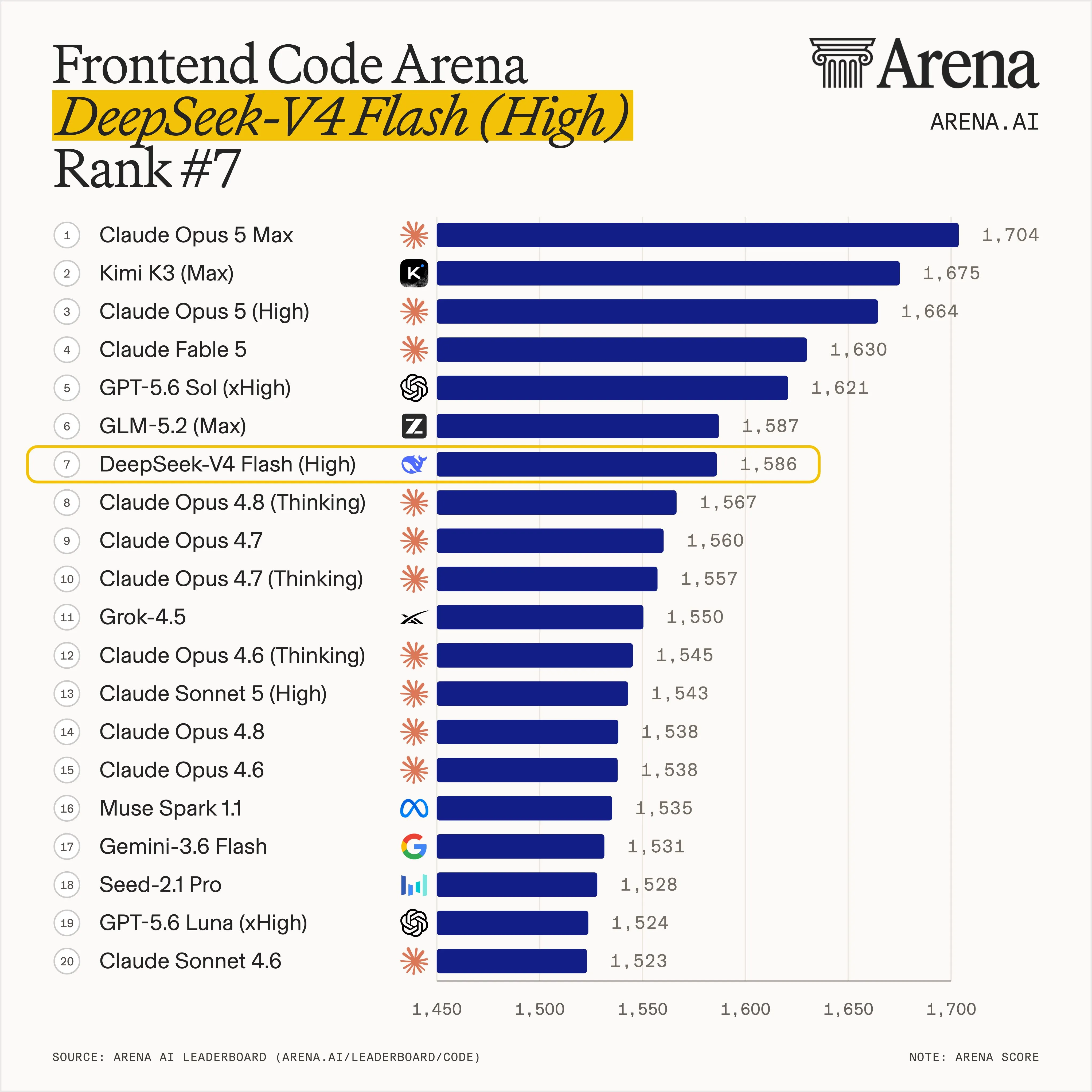
The DeepSeek V4 preview models had a lot of potential, but lacked proper post-training, causing them to be fairly useless in the real world. DeepSeek is back now, with a much improved post-training pipeline, and have released a new version of their smaller (~230 billion parameter) Flash model.
While not being the best model, it is extremely good for coding tasks, especially at its price point.
| Model | $ per million (input) | $ per million (output) | Tokens per second |
|---|---|---|---|
| DeepSeek V4 Flash | $0.09 | $0.18 | 106 |
| Kimi K3 | $3 | $15 | 27 |
| GLM 5.2 | $1.40 | $4.40 | 47 |
| GPT 5.6 Luna | $0.2 | $1.20 | 73 |
Its cached input token cost ratio is 10x better than the other models (10x vs 100x cheaper for cached input tokens). These are the majority of tokens that you use in agentic scenarios, so you can expect to save even more than the sticker price would entail.
It is an extremely capable small model, and you can get far for very little, competing with and even beating GPT 5.6 Luna (which also got an 80% price decrease this week) on the cost-to-performance frontier.
If you were to run this model at 100 tokens per second for 24 hours straight, it would only cost $1.55, or only 6.5 cents per hour.
If you are looking to optimize your costs, this is a competitive model. I cannot wait to see what they do with the larger DeepSeek V4 model in the coming weeks.
Quick Hits
Codex Security CLI
Last week Huggingface got hacked by OpenAI models, but couldn’t use OpenAI models to help diagnose what happened and defend themselves. This highlighted a power imbalance that favored the attacker, so to help level the playing field and get users access to models to help cybersecurity defense, OpenAI has released the Codex Security CLI.
The CLI allows you to scan your repositories for vulnerabilities. It is not a full-featured terminal app where you can prompt the model; instead, you pass in a knowledge base path for the model to understand what your codebase is meant for. It works with your regular ChatGPT subscription, but you will need to verify your identity to be able to use it.
It is not a full fix for the issues that we will experience as defenders against cyber attacks, but it is a start and it is good to see that OpenAI is taking it seriously (unlike Anthropic).
Finish
I hope you enjoyed the news this week. If you want to get the news every week, be sure to join our mailing list below.