Releases
Claude Fable
Anthropic has released their highly anticipated Claude Mythos model under the name Claude Fable. It is not the exact Mythos Preview model that people got access to as a part of Project Glasswing, but rather a model from that family (different finetune of the model).
The main difference from Mythos to Fable is the increase in safety guardrails to prevent the model from engaging in harmful activities like biology and cybersecurity.
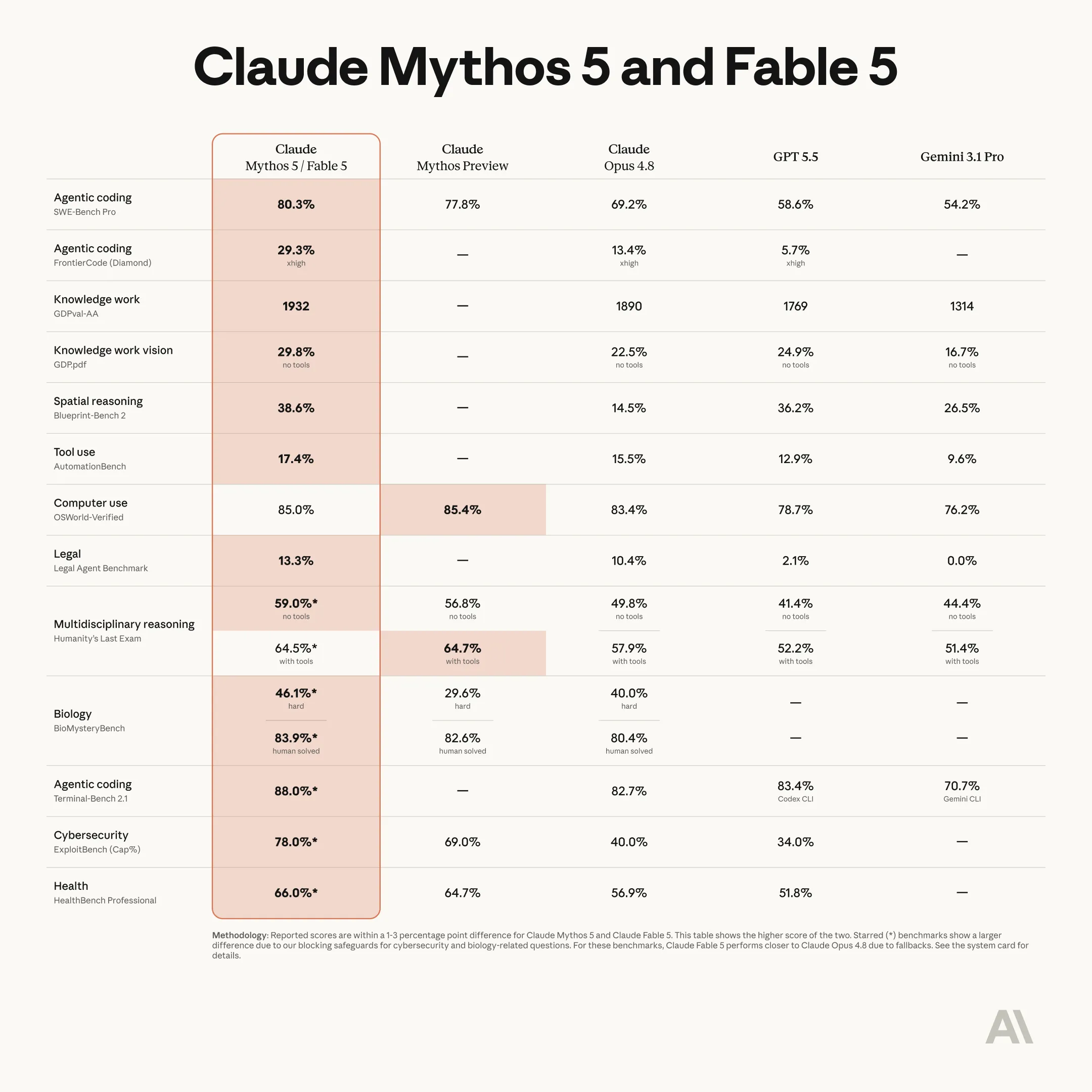
To be rather blunt: this is the best LLM out there right now for text based tasks, if you are willing to foot the rather large bill for it.
It is the best at frontend design, coding, and agentic tasks.
Anthropic clearly does not care about vision capabilities, as Fable is the about as good as the mid size Qwen 3.6 models on vision benchmarks.
As for pricing, its 2x the price of Opus.
It also uses more tokens than GPT 5.5 xhigh on similar questions, so expect it to be 3-5x more expensive in the real world than GPT 5.5.
OpenAI continues to be far ahead of every other lab at squeezing the most intelligence out of the fewest tokens.
| Model | $ per million (input) | $ per million (output) | Tokens per second |
|---|
| Claude Fable 5 | $10 | $50 | 40 |
| Claude Opus 4.8 | $5 | $25 | 60 |
| GPT 5.5 | $5 | $30 | 51 |
There is also the issue of the safety filters. If you are a biologist, sorry to say but you won’t be able to use Fable whatsoever. Anthropic has decided the best way to prevent any bio safety risks is to make the model refuse anything bio related, including “Is mitochondria the powerhouse of the cell?”.
They also have safety filters for cybersecurity tasks (Mythos originally got famous for being very good at hacking things) and also advanced machine learning topics.
The machine learning filter gathered the ire of the community specifically. For all other topics, when a safety filter is triggered, the user would be informed that they had triggered the filter and were being rerouted to Opus. For machine learning tasks, Anthropic thought they could sneak in the fact that the user would not be notified, thereby sandbagging the results and silently giving the user worse performance, which was seen as very underhanded and actively hostile towards the community.
All of this is a moot point right now, since 3 days after its release, Fable access has been removed for everyone, following an export control directive from the US government that suspended all access to any foreign nationals (anyone not a US citizen) both inside the US and out. This includes any Anthropic employees that are foreign nationals as well. The only way that Anthropic was able to abide by this ruling was to turn off access for all customers.
What appears to have happened is that one of the enterprises using Fable (supposedly Amazon, a major Anthropic investor) was able to jailbreak the model and bypass the safety filters for cybersecurity, and reported this to the US government.
The US government, upon hearing this, and the fear mongering that Anthropic propagated with the initial Mythos announcement about how dangerous of a hacking tool it could be, decided that they did want any foreign adversaries to have access to the model, and issued their decree.
I don’t think Anthropic is necessarily upset about this.
They have always wanted nobody else other than them to be working on powerful AI systems, and this new ruling sets the precedent that at a certain capability level you should expect the US government to step in and make things messy.
This could effectively limit the companies who can work on AGI in the US to only the big players that have the money and lobbying power to convince the US to allow them to continue working on these systems.
This would mean that only the likes of Anthropic, OpenAI, and Google may be able to effectively work on these systems in the future.
This has caused quite a bit of chaos in the AI world.
OpenAI has seen a large shift as users head to their platform in response to Anthropic’s treatment of the ML community.
Many individuals and companies have also announced that they will begin working on their own models and finetunes, to prevent losing access to models in the future, and also not have a third party dictate what they can or cannot use a model for.
I expect Anthropic and the US to sort out their issues and Fable to return in the following weeks.
This is clearly an inflection point in the AI race, and we will be feeling the effects of this for a long time to come.
Quick Hits
Kimi K2.7 Code
Speaking of open source models, let’t talk about MoonshotAI’s new Kimi K2.7 Code model.
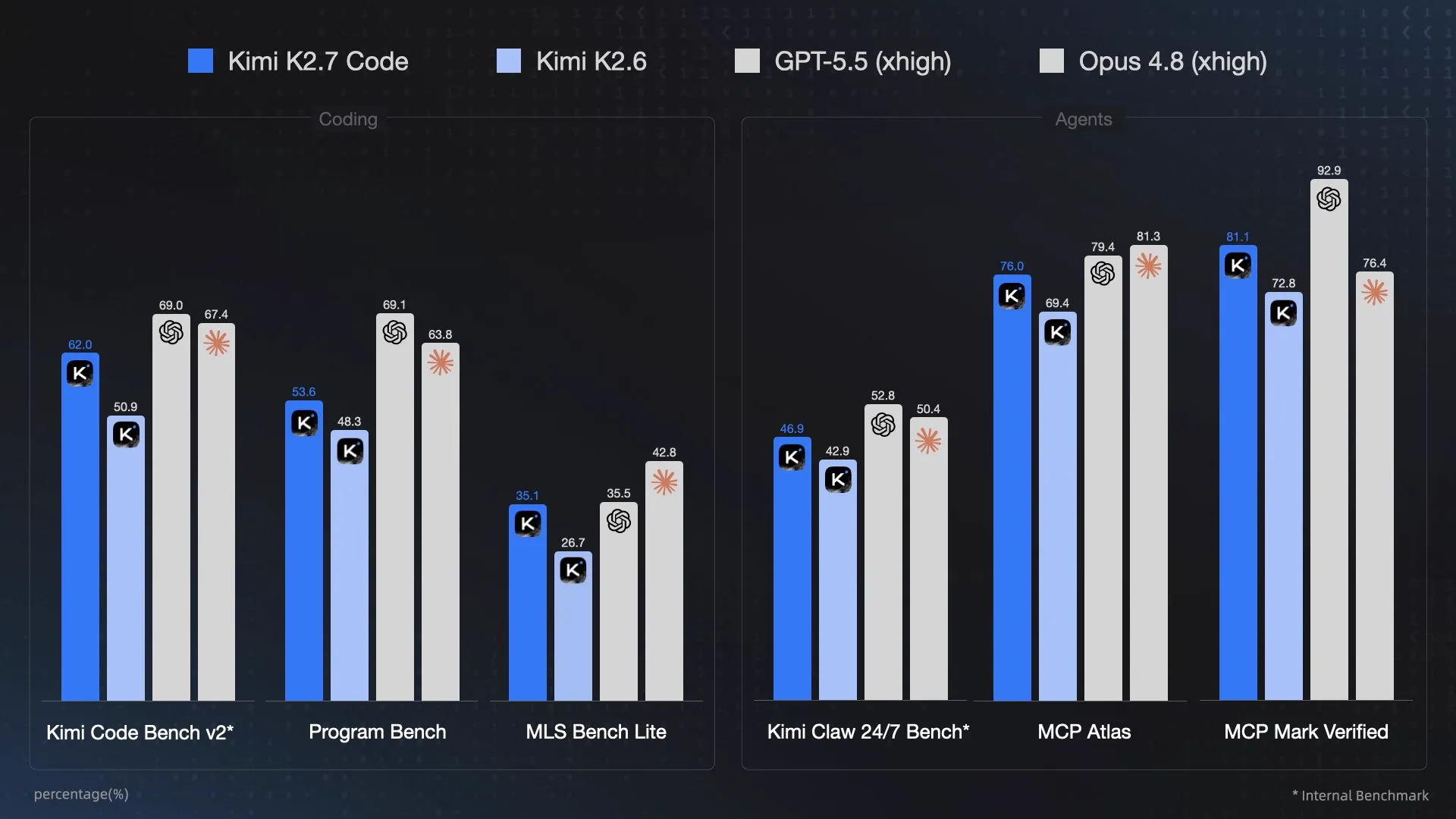
This is a coding specific finetune built on top of their K2.6 model.
I think I was a bit harsh in my Kimi K2.6.
As time has gone on it seems to be a decent model, roughly in line with all of the other frontier Chinese models.
They also seemed to have cleaned up their benchmaxxing a bit, as I think pretty much everyone had caught on that the scores they were showing were meaningless and were not driving adoption.
Now the scores that they show are clearly below the likes of GPT and Claude, but also a nice bump up from the previous version.
They also have worked on getting token usage down, reducing token use by 30%.
This model has flown under the radar a bit due to all of the Fable drama, but from the bits that I have seen from it I would say it’s among the best open source coding models out there right now.
Finish
I hope you enjoyed the news this week. If you want to get the news every week, be sure to join our mailing list below.
 Shangchen Bathhouse in Hangzhou, China, designed by Wei Zhixue.
Nota: Este artigo foi traduzido automaticamente com OpenAI GPT-5.5 por meio do Codex CLI; a qualidade pode estar reduzida, especialmente na terminologia técnica.
Lançamentos
Claude Fable
A Anthropic lançou seu aguardadíssimo modelo Claude Mythos com o nome Claude Fable. Não é exatamente o modelo Mythos Preview ao qual as pessoas tiveram acesso como parte do Project Glasswing, mas sim um modelo dessa família (um finetune diferente do modelo).
A principal diferença do Mythos para o Fable é o aumento das barreiras de segurança para impedir que o modelo se envolva em atividades nocivas, como biologia e cibersegurança.
Para ser bem direto: este é o melhor LLM disponível agora para tarefas baseadas em texto, se você estiver disposto a pagar a conta bem alta por ele.
Ele é o melhor em design de frontend, programação e tarefas agentivas.
A Anthropic claramente não se importa com capacidades de visão, já que o Fable é mais ou menos tão bom quanto os modelos Qwen 3.6 de porte médio em benchmarks de visão.
Quanto ao preço, ele custa 2x o preço do Opus.
Ele também usa mais tokens do que o GPT 5.5 xhigh em perguntas semelhantes, então espere que ele seja 3-5x mais caro no mundo real do que o GPT 5.5.
A OpenAI continua muito à frente de todos os outros laboratórios em extrair o máximo de inteligência do menor número de tokens.
| Modelo | US$ por milhão (entrada) | US$ por milhão (saída) | Tokens por segundo |
|---|
| Claude Fable 5 | $10 | $50 | 40 |
| Claude Opus 4.8 | $5 | $25 | 60 |
| GPT 5.5 | $5 | $30 | 51 |
Há também a questão dos filtros de segurança. Se você é biólogo, lamento dizer, mas não poderá usar o Fable de jeito nenhum. A Anthropic decidiu que a melhor forma de prevenir quaisquer riscos de biossegurança é fazer o modelo recusar qualquer coisa relacionada a biologia, incluindo “A mitocôndria é a usina de energia da célula?”.
Eles também têm filtros de segurança para tarefas de cibersegurança (o Mythos ficou famoso originalmente por ser muito bom em hackear coisas) e também para tópicos avançados de machine learning.
O filtro de machine learning atraiu a ira da comunidade em especial. Para todos os outros tópicos, quando um filtro de segurança era acionado, o usuário era informado de que havia acionado o filtro e estava sendo redirecionado para o Opus. Para tarefas de machine learning, a Anthropic achou que poderia esconder o fato de que o usuário não seria notificado, prejudicando deliberadamente os resultados e entregando silenciosamente ao usuário um desempenho pior, o que foi visto como muito dissimulado e ativamente hostil à comunidade.
Tudo isso é irrelevante agora, já que, 3 dias após o lançamento, o acesso ao Fable foi removido para todos, após uma diretiva de controle de exportação do governo dos EUA que suspendeu todo acesso de cidadãos estrangeiros (qualquer pessoa que não seja cidadã dos EUA), tanto dentro quanto fora dos EUA. Isso inclui também quaisquer funcionários da Anthropic que sejam cidadãos estrangeiros. A única forma de a Anthropic cumprir essa decisão foi desligar o acesso para todos os clientes.
O que parece ter acontecido é que uma das empresas que usavam o Fable (supostamente a Amazon, uma grande investidora da Anthropic) conseguiu fazer jailbreak do modelo e contornar os filtros de segurança para cibersegurança, e relatou isso ao governo dos EUA.
O governo dos EUA, ao ouvir isso, e diante do alarmismo que a Anthropic propagou com o anúncio inicial do Mythos sobre quão perigoso ele poderia ser como ferramenta de hacking, decidiu que não queria que adversários estrangeiros tivessem acesso ao modelo e emitiu seu decreto.
Não acho que a Anthropic esteja necessariamente chateada com isso.
Eles sempre quiseram que ninguém além deles trabalhasse em sistemas poderosos de IA, e essa nova decisão estabelece o precedente de que, a partir de certo nível de capacidade, você deve esperar que o governo dos EUA intervenha e complique as coisas.
Isso poderia efetivamente limitar as empresas que podem trabalhar em AGI nos EUA apenas aos grandes players que têm dinheiro e poder de lobby para convencer os EUA a permitir que continuem trabalhando nesses sistemas.
Isso significaria que apenas nomes como Anthropic, OpenAI e Google talvez consigam efetivamente trabalhar nesses sistemas no futuro.
Isso causou bastante caos no mundo da IA.
A OpenAI viu uma grande migração, com usuários indo para sua plataforma em resposta ao tratamento da Anthropic à comunidade de ML.
Muitas pessoas e empresas também anunciaram que começarão a trabalhar em seus próprios modelos e finetunes, para evitar perder acesso a modelos no futuro e também para não ter um terceiro ditando para que podem ou não usar um modelo.
Espero que a Anthropic e os EUA resolvam seus problemas e que o Fable retorne nas próximas semanas.
Este é claramente um ponto de inflexão na corrida da IA, e sentiremos os efeitos disso por muito tempo.
Notas rápidas
Kimi K2.7 Code
Falando em modelos open source, vamos falar do novo modelo Kimi K2.7 Code da MoonshotAI.
Este é um finetune específico para programação, construído em cima do modelo K2.6 deles.
Acho que fui um pouco duro no meu Kimi K2.6.
Com o passar do tempo, ele parece ser um modelo decente, mais ou menos alinhado com todos os outros modelos chineses de fronteira.
Eles também parecem ter limpado um pouco o benchmaxxing, já que acho que praticamente todo mundo havia percebido que as pontuações que eles mostravam não significavam nada e não estavam impulsionando a adoção.
Agora as pontuações que eles mostram estão claramente abaixo de nomes como GPT e Claude, mas também representam uma boa melhoria em relação à versão anterior.
Eles também trabalharam para reduzir o uso de tokens, diminuindo o consumo em 30%.
Este modelo passou um pouco despercebido por causa de todo o drama do Fable, mas, pelo pouco que vi dele, eu diria que está entre os melhores modelos open source de programação disponíveis agora.
Final
Espero que você tenha gostado das notícias desta semana. Se quiser receber as notícias toda semana, não deixe de entrar na nossa lista de e-mails abaixo.
Shangchen Bathhouse em Hangzhou, China, projetado por Wei Zhixue.Nota: Este artículo fue traducido automáticamente con OpenAI GPT-5.5 mediante Codex CLI; la calidad puede verse degradada, especialmente en la terminología técnica.
Lanzamientos
Claude Fable
Anthropic ha lanzado su esperadísimo modelo Claude Mythos bajo el nombre Claude Fable. No es exactamente el modelo Mythos Preview al que algunas personas tuvieron acceso como parte de Project Glasswing, sino más bien un modelo de esa familia (un finetune diferente del modelo).
La principal diferencia de Mythos a Fable es el aumento de las barreras de seguridad para evitar que el modelo participe en actividades dañinas como biología y ciberseguridad.
Para ser bastante directo: este es el mejor LLM que existe ahora mismo para tareas basadas en texto, si estás dispuesto a pagar la factura bastante elevada que implica.
Es el mejor en diseño frontend, programación y tareas agenticas.
Anthropic claramente no se preocupa por las capacidades de visión, ya que Fable es más o menos tan bueno como los modelos Qwen 3.6 de tamaño medio en benchmarks de visión.
En cuanto al precio, cuesta 2 veces más que Opus.
También usa más tokens que GPT 5.5 xhigh en preguntas similares, así que espera que sea 3-5 veces más caro en el mundo real que GPT 5.5.
OpenAI sigue estando muy por delante de cualquier otro laboratorio en exprimir la mayor inteligencia posible del menor número de tokens.
| Modelo | $ por millón (input) | $ por millón (output) | Tokens por segundo |
|---|
| Claude Fable 5 | $10 | $50 | 40 |
| Claude Opus 4.8 | $5 | $25 | 60 |
| GPT 5.5 | $5 | $30 | 51 |
También está el problema de los filtros de seguridad. Si eres biólogo, lamento decirlo, pero no podrás usar Fable en absoluto. Anthropic ha decidido que la mejor forma de prevenir cualquier riesgo de bioseguridad es hacer que el modelo rechace cualquier cosa relacionada con biología, incluso “Is mitochondria the powerhouse of the cell?”.
También tienen filtros de seguridad para tareas de ciberseguridad (Mythos originalmente se hizo famoso por ser muy bueno hackeando cosas) y también para temas avanzados de machine learning.
El filtro de machine learning provocó la ira de la comunidad en particular. Para todos los demás temas, cuando se activaba un filtro de seguridad, se informaba al usuario de que había activado el filtro y que estaba siendo redirigido a Opus. Para tareas de machine learning, Anthropic pensó que podía colar el hecho de que el usuario no sería notificado, perjudicando así los resultados y dándole silenciosamente al usuario peor rendimiento, algo que se vio como muy turbio y activamente hostil hacia la comunidad.
Todo esto es un punto discutible ahora mismo, ya que 3 días después de su lanzamiento, el acceso a Fable fue retirado para todos, tras una directiva de control de exportaciones del gobierno de EE. UU. que suspendió todo acceso a cualquier extranjero (cualquiera que no sea ciudadano estadounidense) tanto dentro como fuera de EE. UU. Esto incluye también a cualquier empleado de Anthropic que sea extranjero. La única forma en que Anthropic pudo cumplir con esta resolución fue desactivar el acceso para todos los clientes.
Lo que parece haber ocurrido es que una de las empresas que usaban Fable (supuestamente Amazon, un importante inversor de Anthropic) logró hacer jailbreak al modelo y eludir los filtros de seguridad para ciberseguridad, y reportó esto al gobierno de EE. UU.
El gobierno de EE. UU., al enterarse de esto, y del alarmismo que Anthropic propagó con el anuncio inicial de Mythos sobre lo peligroso que podría ser como herramienta de hacking, decidió que no quería que ningún adversario extranjero tuviera acceso al modelo, y emitió su decreto.
No creo que Anthropic esté necesariamente molesta por esto.
Siempre han querido que nadie más aparte de ellos trabaje en sistemas de IA potentes, y esta nueva resolución sienta el precedente de que, a cierto nivel de capacidad, deberías esperar que el gobierno de EE. UU. intervenga y complique las cosas.
Esto podría limitar efectivamente las empresas que pueden trabajar en AGI en EE. UU. únicamente a los grandes actores que tienen el dinero y el poder de lobby para convencer a EE. UU. de que les permita seguir trabajando en estos sistemas.
Esto significaría que solo empresas como Anthropic, OpenAI y Google podrían trabajar efectivamente en estos sistemas en el futuro.
Esto ha causado bastante caos en el mundo de la IA.
OpenAI ha visto un gran desplazamiento a medida que los usuarios se dirigen a su plataforma en respuesta al trato de Anthropic hacia la comunidad de ML.
Muchas personas y empresas también han anunciado que empezarán a trabajar en sus propios modelos y finetunes, para evitar perder acceso a modelos en el futuro, y también para no permitir que un tercero dicte para qué pueden o no pueden usar un modelo.
Espero que Anthropic y EE. UU. resuelvan sus problemas y que Fable vuelva en las próximas semanas.
Esto es claramente un punto de inflexión en la carrera de la IA, y sentiremos sus efectos durante mucho tiempo.
Notas rápidas
Kimi K2.7 Code
Hablando de modelos open source, hablemos del nuevo modelo Kimi K2.7 Code de MoonshotAI.
Este es un finetune específico para programación construido sobre su modelo K2.6.
Creo que fui un poco duro en mi Kimi K2.6.
Con el tiempo parece ser un modelo decente, más o menos en línea con todos los demás modelos frontier chinos.
También parece que han limpiado un poco su benchmaxxing, ya que creo que prácticamente todo el mundo se había dado cuenta de que las puntuaciones que mostraban no significaban nada y no estaban impulsando la adopción.
Ahora las puntuaciones que muestran están claramente por debajo de las de GPT y Claude, pero también representan una buena mejora respecto a la versión anterior.
También han trabajado en reducir el uso de tokens, reduciéndolo en un 30%.
Este modelo ha pasado un poco desapercibido debido a todo el drama de Fable, pero por lo que he visto de él, diría que está entre los mejores modelos open source de programación que existen ahora mismo.
Final
Espero que hayas disfrutado las noticias de esta semana. Si quieres recibir las noticias cada semana, asegúrate de unirte a nuestra lista de correo abajo.
Shangchen Bathhouse en Hangzhou, China, diseñado por Wei Zhixue.